Indian Removal Act
http://www.youtube.com/watch?v=Nfo_LnuDJ1c
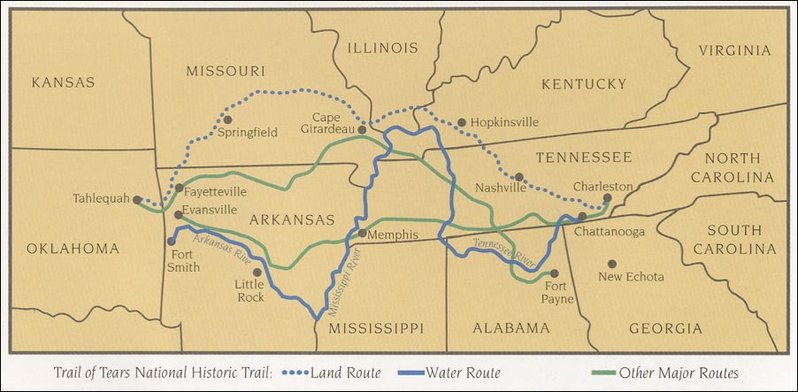
Please watch this video, the link provided above. This video does a fantastic job explaining the conflict with the Indians and the colonists. The Indian Removal Act was signed into law by Andrew Jackson in 1830. This law allowed the president to grant unsettled lands west of the Mississippi in exchange for Indian lands within existing states. A few tribes went peacefully, however majority of them did not agree with this law and were going to try and stay on their lands as long as they could. Between 1838-1839 the Cherokees were forcibly moved westward on the trail of tears.In the Cherokee language, the event is called Nunna daul Isunyi - "the Trail Where We Cried." Many Native Americans suffered from exposure, disease and starvation while traveling on this trail. It was estimated that 4,ooo of the 15,ooo Cherokees died while traveling this long journey.
Tensions between Georgia and the Cherokee Nation were brought to a crisis when the discovery of gold happened in Georgia. This resulted in the first gold rush in U.S. history. Gold speculators began trespassing on Cherokee lands, obviously the Indians did not appreciate their lack of respect.
Pressure was put on Georgia's government to fulfill the promises of the Compact of 1802. When Georgia tried to extend state laws over Cherokee tribal lands, the conflict went to the U.S. Supreme Court. In Cherokee Nation vs. Georgia, the Marshall court ruled that the Cherokees were not a sovereign and independent nation, and therefore refused to hear the case. However, in Worcester vs. State of Georgia, the Court ruled that Georgia could not impose laws in Cherokee territory, since only the national government - not state governments - had authority in Indian affairs.
Jackson was fully committed to the policy of Indian removal. He had no desire to use the power of the national government to protect the Cherokees from Georgia. Over time this conflict continues as the westward expansion grows. The Indians continue to have no rights to land, and they are pushed to the side continuously. The result of this took a large toll on not only the Indians but the American government. The Indian tribes no longer had any trust with the Americans and were very cautious of who they let into their lives. This act destroyed the bonds between the indians and Americans.
Map of the "Trail of Tears"